
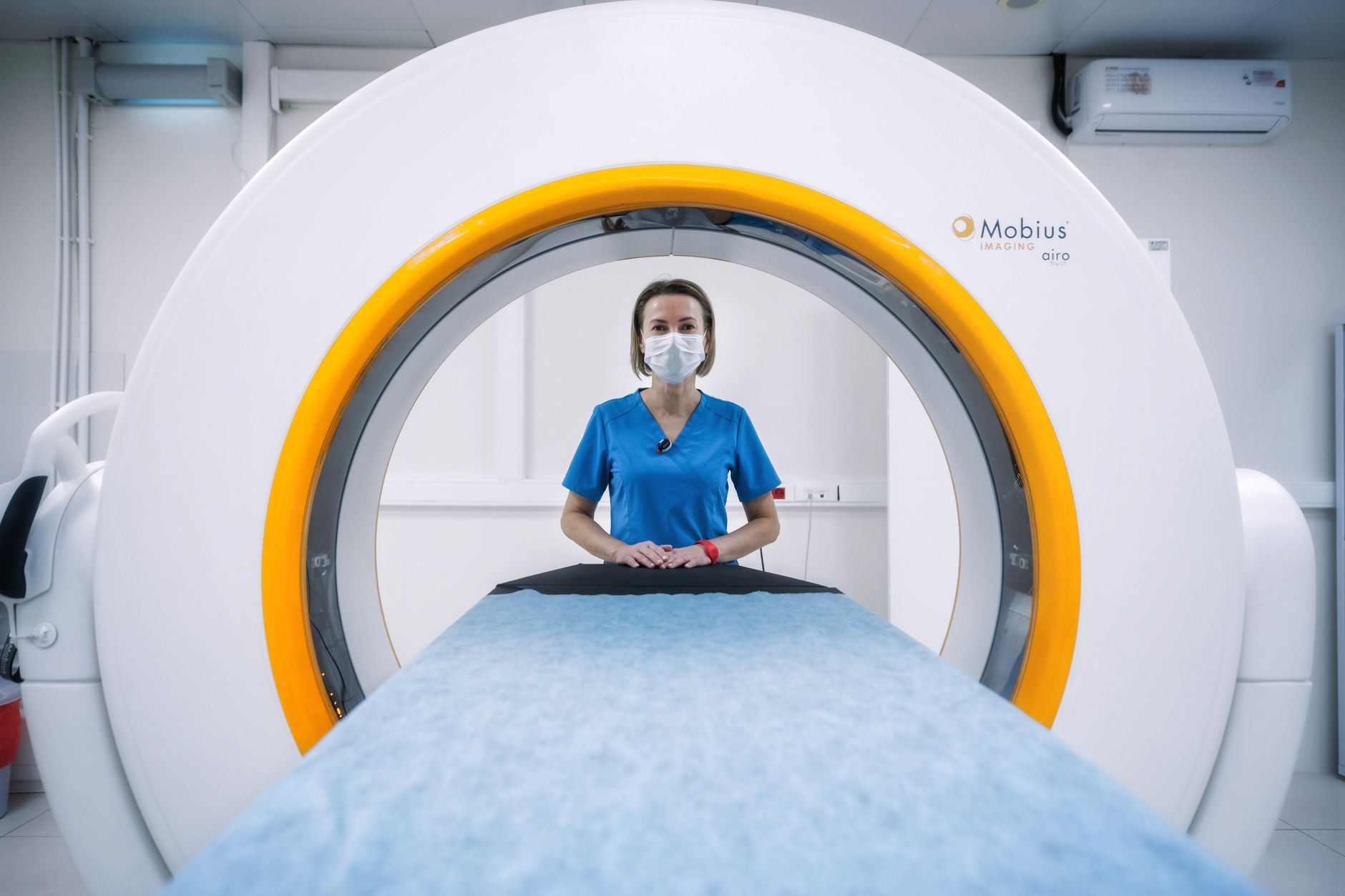
Here’s a group of people who spend their workdays inside some of the strongest magnetic fields humans ever encounter: MRI technologists, radiologists and the nurses who help patients in and out of the scanner.
A 2024 review in a leading German radiology journal pulled together everything known about their health. I’m including it in this hub because it’s a rare look at how the medical world itself studies EMF exposure in its own staff — and because its findings are more nuanced than either side of the EMF debate usually admits.
Study at a glance
- Title
- Health risks for medical personnel due to magnetic fields in magnetic resonance imaging
- Authors
- Alexander Marc König, Antje Pöschke, Andreas H. Mahnken
- Journal
- RöFo (Fortschritte auf dem Gebiet der Röntgenstrahlen), 2024
- Scope
- 7,273 sources screened, 34 included
- Exposure
- Static and movement-induced magnetic fields around clinical MRI (typically 1.5–3 tesla; research systems up to 17.6 T)
What the review found
The authors’ bottom line: short-term effects are well documented and usually pass, and there are significant research gaps about what years of chronic exposure might do.
What this means for moms
I appreciate this review for its honesty. It shows that magnetic fields can measurably affect how our nervous systems work in the moment — that part is no longer controversial in occupational medicine. It also shows that, in the pregnancy data available, MRI staff didn’t see worse outcomes.
Both of those things can be true at once, and I think our community is stronger when we say so. It’s the same lesson as the gene switch study: the questions that matter most are how strong, how long, how often, and how close.
If you work in healthcare — or you’re pregnant and work around imaging equipment — this review is worth sharing with your employer’s safety officer.
The honest part: An MRI’s main magnetic field is static and very strong; the RF from Wi-Fi and phones is a different kind of exposure, so these results don’t transfer directly to your home. The review also notes low questionnaire return rates in some studies (around 30%) and a lack of large epidemiological studies.
If you work around strong fields
- Move slowly near the magnetMany symptoms come from moving through the field quickly.
- Ask about the dataYour employer should track exposure and symptoms.
- Pregnancy planTalk with occupational health about your role and positioning during pregnancy.
- Recovery at homeLower your exposure where you can control it — especially overnight.
Want one simple step for your home? Aires is the EMF protection I use in my own home and for my own kids.
Sources
- König AM, Pöschke A, Mahnken AH. Health risks for medical personnel due to magnetic fields in magnetic resonance imaging. RöFo. 2024. doi:10.1055/a-2296-3860
This article is an accessible summary of published research for a general audience. It is educational content only and is not medical advice. Please talk with your own healthcare provider about your family’s specific situation.