
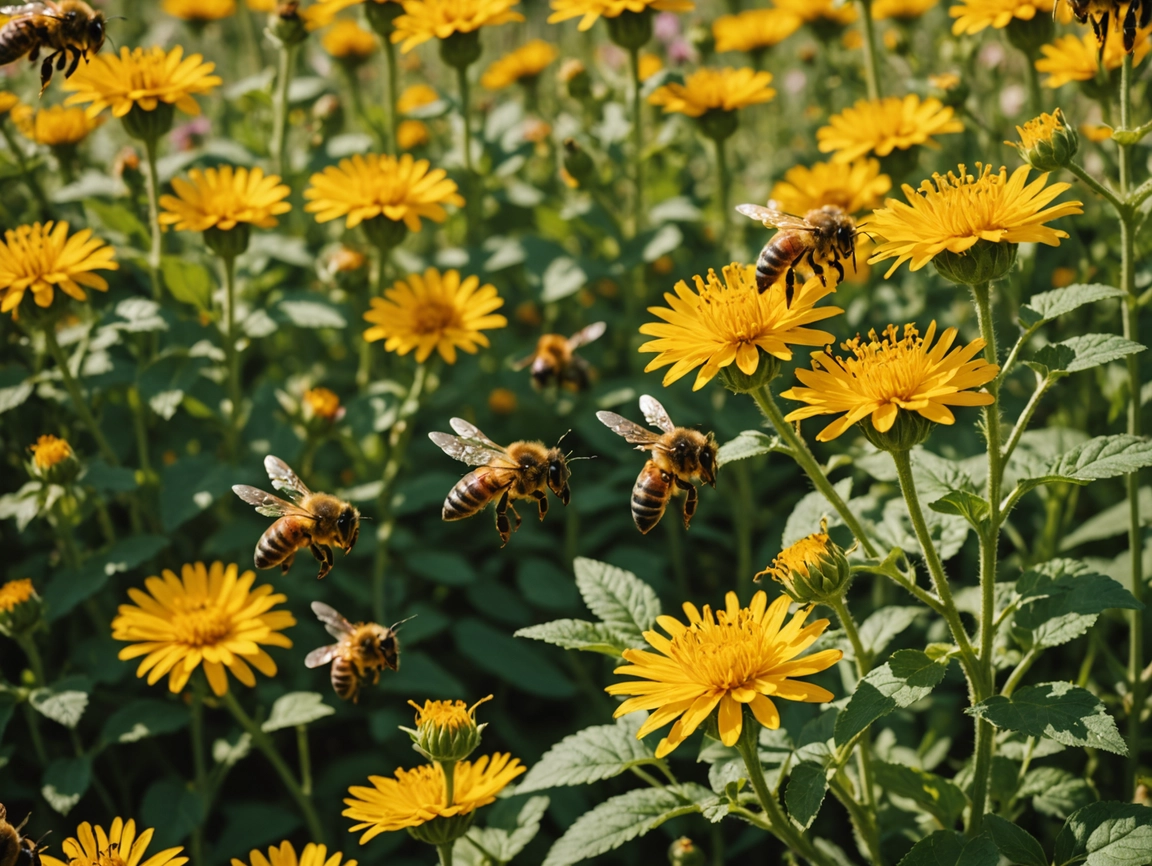
I’ve always had a soft spot for bees. There’s something about watching one buzz around my yard so purposeful, so quietly essential that just makes me feel like the world is still working the way it should. So when I came across this study, I had to share it. Because it turns out the world might not be working quite as well as we hoped.
First, a little love letter to bees
Bees pollinate roughly one-third of everything we eat. Almonds. Apples. Blueberries. Coffee (yes, coffee). Without them, our grocery stores would look heartbreakingly bare and our ecosystems would unravel in ways that ripple far beyond the produce aisle. They’re doing all of this quietly, tirelessly, for free and they’ve been doing it long before we were even a species worth pollinating for.
They already face so much: pesticides, habitat destruction, disease, climate disruption. The list of threats is long and honestly exhausting to think about. But a study published in Science Advances in 2023 added something new to that list: something invisible, and something very much man-made.
The thing in the air we don’t think about
Researchers in Chile led by M. A. Medel-Morales and colleagues wanted to know whether the electromagnetic fields (EMF) coming off high-voltage power lines were affecting honeybees. Not in some vague, hard-to-measure way. In a real, measurable, ecologically significant way.
Spoiler: they were.
2× Stress protein (Hsp70) spike in just 5 minutes near active towers
308% Fewer flower visits by bees near energized EMF sources
⅓ Of our food crops depend on bee pollination
The team set up observations around both active and inactive power transmission towers, and ran controlled lab experiments exposing bees to EMF levels common near power lines worldwide — around 7–10 microtesla, the kind of field you’d find if you lived near high-voltage infrastructure.
Within just five minutes of exposure, stress markers in the bees spiked dramatically. Heat-shock proteins doubled. Antioxidant stress genes surged. Meanwhile, the genes that govern foraging, memory, navigation, and even the bees’ ability to sense magnetic fields — all of that was being suppressed. And behaviorally? Bees visited flowers near active towers dramatically less often. Plants near those towers produced significantly fewer seeds when left to natural pollination. When researchers hand-pollinated those same plants? The difference vanished. It wasn’t the soil. It wasn’t the weather. It was the bees not showing up.
And it’s not just power lines
Here’s where I want to bring in something else I’ve been reading. The team at Aires did their own multi-stage bee study, and they were specifically looking at 5G radiation, the kind that’s expanding rapidly as our wireless infrastructure grows. Their findings pointed in the same direction: EMF exposure can cause oxidative stress in bees, disrupt their ability to navigate and communicate, and even affect queen bee fertility and honey production.
Why this feels personal to me
Here’s the part that sat with me after I put down the study and went to make dinner.
If invisible, man-made EMF fields are measurably disrupting the biology of bees, creatures that have been navigating Earth’s electromagnetic environment for millions of years, what might they be doing to the rest of us? That’s not a conspiracy. That’s just a reasonable question to sit with. Bees are, in many ways, the canary in the coal mine. Their nervous systems are finely tuned. Their navigation depends on sensing the planet’s own magnetic field. And we’ve layered our own electromagnetic noise on top of that ancient signal.
The researchers note that this isn’t just a problem for one flower patch near one power line. Disrupted pollination cascades through entire ecosystems reducing plant reproduction, biodiversity, food for wildlife, and yes, food for us. In vulnerable agricultural regions, widespread EMF exposure could cut crop yields by 8% or more. In a world already worried about food security, that’s not a number to brush past.
What this is and isn’t
I want to be clear: this article isn’t a call to tear down power lines or throw your WiFi router in the bin. It’s a “nice to know.” It’s the kind of information I want on my radar as a parent, as someone who cares about healthy food and the importance of organic food production as a person who cares about what we’re leaving behind for our kids.
The researchers themselves are calling for smarter infrastructure planning, thoughtful placement of towers, continued research into EMF shielding, and broader awareness that bees are not separate from us. What harms them quietly, invisibly, over time, is worth paying attention to. Because the same invisible fields that are stressing out our pollinators exist in the same world our children are growing up in.
Bees have been doing their quiet, essential work for tens of millions of years. They don’t ask for anything. They just show up, do the work, and keep the whole living world turning. The least we can do is notice when something we built is getting in their way and maybe ask what that says about what it’s doing to us, too.
Sources: Medel-Morales, M. A. et al. (2023). “Anthropogenic electromagnetic fields disrupt pollination services.” Science Advances. | Aires Tech (2023). “Bees + EMF: Aires Tech Research Overview.” Aires. This article is intended as an accessible summary for general audiences.
Ready to lower your family’s EMF exposure? Aires is the EMF protection I use in my own home, for my own kids — and Moms Against EMF readers get 25% off every single order.