

If you’ve Googled “toddler tantrums” at 10pm after a particularly rough bedtime battle, you already know what’s out there: count to five, get on their level, name the feeling, offer two choices. All good advice. All things you’ve probably already tried.
But if you’re anything like me, you’ve noticed that the mainstream tantrum advice treats every meltdown the same way; as a purely emotional or behavioral event that needs a script. What it doesn’t talk about is the environment your toddler is living in every single day, and how much of that environment is quietly cranking up their nervous system before the tantrum even starts.
I’m not talking about discipline strategies here. I’m talking about the stuff hiding in plain sight.
Here’s the honest part upfront: none of this is a magic switch. If you try one of the following tips tonight expecting a calm toddler by morning, you’ll be disappointed. Toddlers are in the middle of some of the most intense developmental changes of their entire lives — language explosions, independence-seeking, emotional regulation systems that are still under construction. Give any change a few days to a few weeks before you look for results. That’s not a caveat to lower your expectations; it’s just how nervous systems and habits actually work, in kids and adults alike.
Let’s get into it.
1. Remove Processed Sugar (Even the “Healthy” Kind)
This is the one that surprised me the most, and it’s the one I noticed working the fastest. I’m talking real, visible changes in my toddler within 2-3 days of cutting it out.
Here’s the thing about sugar: it’s not just in candy and cookies. It’s in the fruit snacks marketed as a wholesome lunchbox staple. It’s in flavored yogurt, granola bars, crackers, bread, pasta sauce, and even some varieties of “toddler-friendly” applesauce. Once you actually start flipping labels over, you start seeing sugar (or its aliases — cane syrup, fruit juice concentrate, dextrose, etc.) in things you never would have suspected.
Why does this matter for tantrums? Toddlers already have limited capacity to regulate their emotions — their prefrontal cortex, the part of the brain responsible for impulse control and calming down, isn’t fully developed and won’t be for another two decades. Add a sugar spike-and-crash cycle on top of that, and you’re asking an already-immature nervous system to manage a rollercoaster of blood sugar swings, too. The crash after a sugar spike often looks exactly like a tantrum: irritability, crying, overreacting to small things, trouble calming down.
What to actually do: Don’t aim for “no sugar ever” — aim for reading labels on everything for a week and swapping the worst offenders (usually fruit snacks, flavored yogurts, and juice) for whole-food alternatives: actual fruit, plain yogurt with a little cinnamon, or homemade snacks where you control what goes in. Give it 3-5 days of consistency before you expect to see anything shift.
2. Limit or Eliminate Screen Time (Especially During High-Stimulation Windows)
This one’s nuanced, because most parenting content just says “less screen time” and leaves it at that. Here’s the more specific version.
My toddler doesn’t have regular tablet access. But like most parents, there are moments where the TV becomes a tool of survival like when I’m getting my infant down for a nap, a heat-index day in Arizona summer that keeps everyone stuck indoors, or a moment where I just need ten uninterrupted minutes for a work call. And in those stretches, screen time creeps up. What I’ve noticed is a very direct, very fast correlation: when the whininess and attitude start ramping up, it’s almost always tracking back to more screen time than usual.
The fix that works fastest for us, out of everything on this list, is simply turning it off completely for a stretch — sometimes I’ll tell her the TV is “broken” and we’re not watching it right now. Within about a day, the whining and attitude noticeably soften.
Why the fast turnaround? Screens (especially fast-cut children’s content) hit the brain’s dopamine and reward systems in a way that’s overstimulating for a developing nervous system. When that stimulation disappears, toddlers initially protest — but their baseline nervous system arousal drops quickly, often within 24-48 hours, and regulation improves right along with it.
What to actually do: If you notice tantrums trending upward, do an audit of the last few days’ screen time first. If it’s crept up, pull it back hard for a few days rather than gradually. The “it’s broken” or “we’re taking a break from the TV” framing works well because it removes the negotiation entirely — there’s nothing to argue about.
P.S. When you do turn on the TV or tablet for a few minutes, try some of these low-stimulation shows that I choose for my toddler. Low stimulation show recommendations: Daniel Tiger’s Neighborhood, Llama Llama, Trash Truck, Sesame Street, Puffin Rock
3. Turn Their Play and Sleep Spaces Into a Sanctuary From Smart Devices
This is the tip that gets the fewest nods from other parents, but it’s one worth taking seriously: the smart devices, routers, and monitors clustered in a toddler’s bedroom and play space create a layer of background stress that most of us never think to question.
We adults absorb this chaotic electronic “noise” too, but kids — with smaller bodies, developing nervous systems, and brains that are more sensitive to environmental input in general — often show it more visibly. Instead of naming what’s bothering them (something they don’t have the language or awareness to do), it comes out as dysregulation: crankiness, trouble settling, tantrums that seem to come out of nowhere, especially in the spaces where they sleep and play most.
Children have smaller heads than adults. Cell phones and wireless radiation can go deeper into their brains because children have a shorter distance from their skull to their brain center.
EHT.org
What to actually do: Start with an audit of your toddler’s bedroom and main play area. Move routers, smart speakers, baby monitors, and charging stations as far from the crib/bed and play mat as reasonably possible. Consider a wired baby monitor or one with a “eco mode” that reduces transmission when not actively needed. Keep tablets and phones out of the room entirely, even when not in use. This isn’t about achieving a zero-device home — it’s about making the spaces where your child spends the most restorative time (sleep and independent play) as calm as possible.
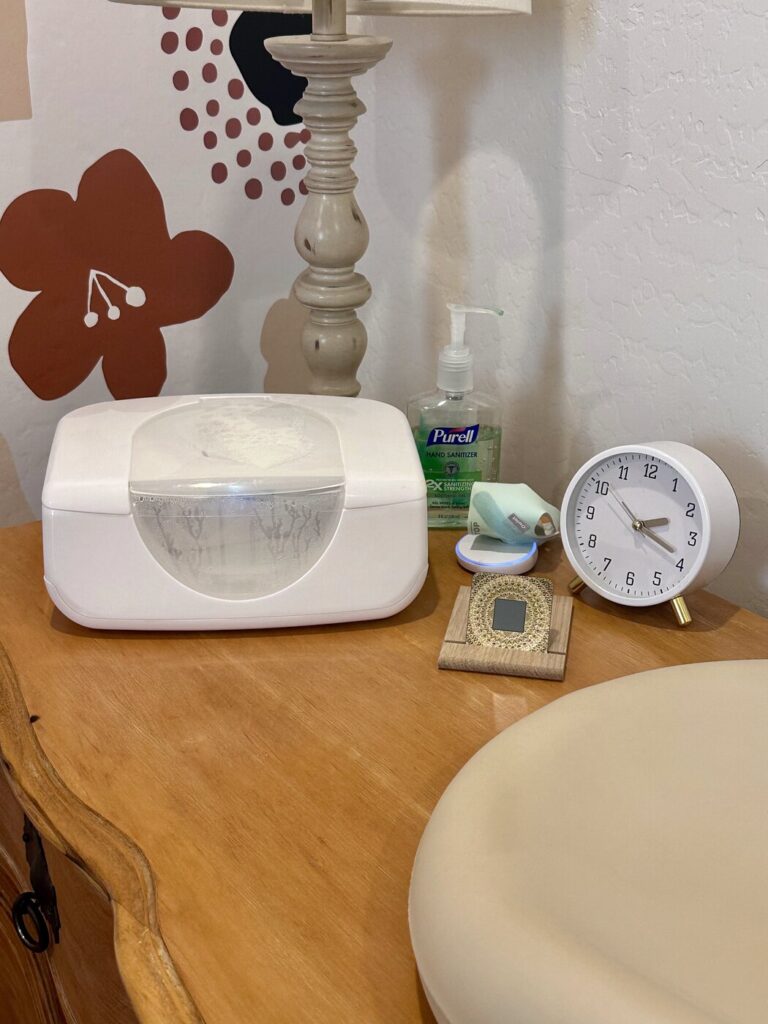
Pro Tip: Take it a step further and make your home environmentally-optimized with Aires devices. These devices are in every room of my home including bedrooms, play areas and even in my car. Designed for all our biological benefit, but our children need it the most. These don’t need to be charged, they are always on 24/7 tuning our living areas from the harmful EMF that our smart devices and cell phones, WiFi etc. are giving off constantly. Check them out here and get 25% off your entire order.
Want to know what’s around your home like cell towers, substations, power lines and more? This is mind-blowing and it’s a free interactive map that shows you your environmental toxic load with EMF sources to give you a visual to the invisible and it gave me even more motivation to bring in a solution like Aires to my home. Check out the EMF Map here!
4. Build in Real Quiet Time — Where “Bored” Is Allowed
Modern toddlerhood is loud. Constant narration from parents, constant background noise, constant stimulation from toys that light up and talk back. What’s missing from a lot of days is unstructured quiet — time where nothing is entertaining them and they have to figure out what to do with themselves.
This matters more than it sounds like it should. Learning to tolerate boredom is a real developmental skill, and it’s one of the building blocks of self-regulation. A toddler who never experiences quiet, low-stimulation time doesn’t get the practice of calming their own nervous system down — they’re always waiting for the next input. And when that input isn’t available (like, say, when you tell them no), the emotional crash can be bigger because they’ve never practiced sitting with “nothing is happening right now.”
What to actually do: Set aside a predictable quiet time block each day — even 15-20 minutes to start. No screens, no adult-led activities, no “let me show you how to do this.” Just books on the floor, blocks, a basket of familiar toys, or genuinely nothing. Expect protest at first — that’s normal and even expected, since this is a new skill. Stick with it consistently for a week or two before judging whether it’s helping.
Pro Tip: When your toddler is starting to boycott daily naps, try a quiet time block instead. This is something that I am currently in the process of transitioning to 1-2 days a week to still get a break for both of during mid-day to still get the benefits of a nap with resetting, relax time.

5. Move Their Bodies: On Purpose, Every Day
This one gets talked about in the sense of “get outside,” but it deserves more specificity than that, because the type of movement matters.
Big, whole-body movement — tumbling, rough-and-tumble wrestling with mom or dad, throwing a ball for the dog, running outside — does something that quiet play doesn’t: it helps discharge built-up physical and emotional energy that would otherwise come out sideways as a meltdown. Even just 10 minutes of sunshine and fresh air can reset a toddler’s mood in a way that indoor play often can’t match, partly because of the movement itself and partly because of the sensory input of being outside; different light, different textures, different sounds.
What to actually do: Build a daily movement block into the rhythm of your day, ideally before the times you know are historically hard (late afternoon is a common tantrum window for a lot of toddlers). Rough play with a parent, animal-crawl races, an obstacle course made of couch cushions, or just time outdoors all count. You don’t need a formal plan, you need consistency.
Why None of These Tantrum Tips Work Overnight (and That’s Okay)
Every one of these tips touches something foundational: blood sugar regulation, nervous system stimulation, environmental stressors, self-soothing skills, and physical energy discharge. None of these are quick fixes because none of the underlying systems change instantly. A toddler’s brain is doing an enormous amount of construction work every single day, and adding new inputs (or removing old ones) takes repetition before the nervous system adapts and a new pattern sets in.
The screen time tip tends to show change fastest, sometimes within a day. Sugar often shows up in 2-3 days. The environmental and quiet-time changes are slower, more like a week or two, because they’re addressing baseline stress levels rather than acute triggers.
The tempting thing as a parent is to try something for a day, not see a total transformation, and assume it’s not working. But you’re not looking for a switch flipping — you’re looking for a slow, steady exhale. Give it time, stay consistent, and pay attention to the direction things are trending rather than expecting a finish line.
The Bottom Line
Toddler tantrums aren’t just a discipline problem to be managed with the right script — they’re often a signal. A signal that something in the body or environment is asking for adjustment: too much sugar, too much stimulation, too little quiet, too little movement, or too much invisible electronic noise in the spaces meant for rest. Address those root layers, give it real time, and the tantrums you’re navigating today often start looking a lot more manageable in a few weeks.
You know your toddler better than anyone. Trust what you’re noticing, make one change at a time if that feels more doable, and give yourself the same grace you’re trying to give them — this stage is hard, and you’re doing better than you think.
Ready to lower your family’s EMF exposure? Aires is the EMF protection I use in my own home, for my own kids — and Moms Against EMF readers get 25% off every single order.