
I read a lot of EMF research. Almost all of it lands in one of two piles: here’s another way this exposure might be hurting us, or here’s a study saying don’t worry about it.
This one didn’t fit either pile. I’ve been turning it over for about a week now.
In May, a team at Dongguk University in South Korea published a paper in Cell — one of the most rigorous journals in all of biology — describing something I genuinely didn’t know was possible. They built a genetic switch you turn on with a magnetic field. No pills. No injections. No surgery. You hold a small coil near the tissue, run 60 hertz through it, and specific genes start expressing. Turn the coil off, and within 24 hours everything settles back to baseline.
In August, the Springer Nature journal Signal Transduction and Targeted Therapy ran a research highlight on it, which is how it crossed my desk. And there’s one piece of this study that I think matters enormously for how our community talks about EMF — and it’s not the piece the headlines are chasing.
The part everyone’s covering: a remote control for genes
The applications the researchers demonstrated read like science fiction, and they’re the reason the story got picked up at all.
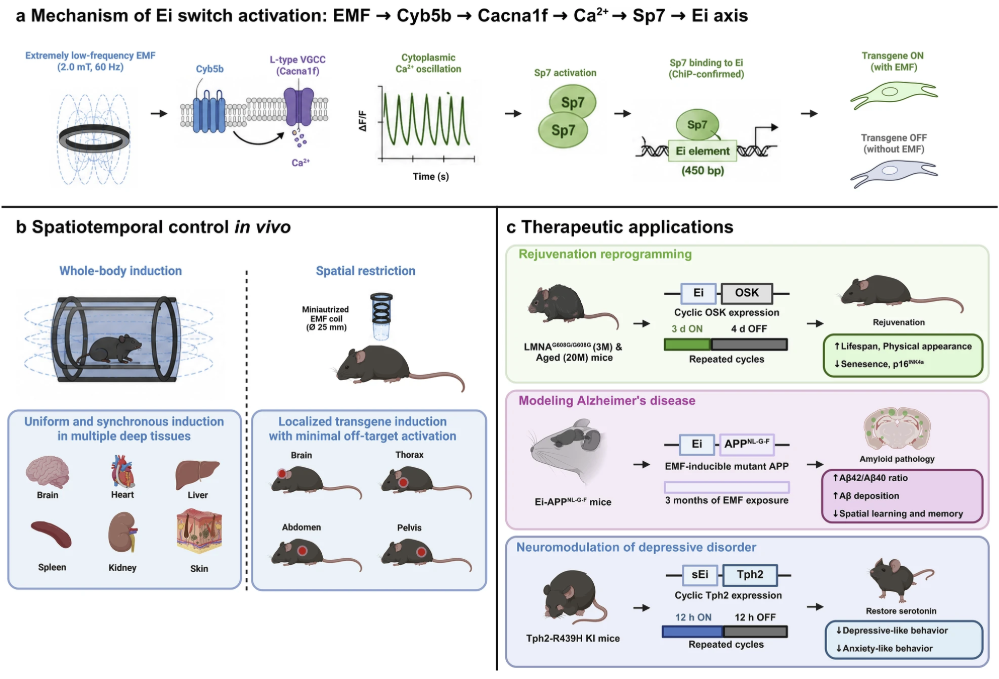
In aged mice, they cycled reprogramming genes on for three days and off for four. Those mice lived measurably longer — both median and maximum lifespan went up — with fewer cellular aging markers and no detectable overgrowth of tissue. In a second experiment, they built a better Alzheimer’s model by switching on amyloid pathology in animals that were already old, which is much closer to how the disease actually shows up in people. In a third, they placed the switch in a serotonin-producing region of the brain and used timed magnetic exposure to restore serotonin and reverse depression- and anxiety-like behavior.
All of that is remarkable. But it’s not what I keep thinking about.
The part I can’t stop thinking about: they found the sensor
For as long as I’ve been reading about EMF, the most common dismissal has been some version of: there’s no plausible biological mechanism. Non-ionizing radiation doesn’t carry enough energy to break a chemical bond, so how could it possibly do anything to a living cell?
This paper describes a mechanism. Not a hypothesis — a named molecule, found through a genome-wide CRISPR screen, with a traceable chain of events behind it.
The molecule is Cyb5b — cytochrome b5 type B, a small protein sitting in cell membranes that I’d never heard of before this study. Here’s the chain the researchers mapped:
- The magnetic field changes the redox state of Cyb5b
- That opens L-type voltage-gated calcium channels
- Which produces rhythmic, sustained calcium oscillations inside the cell
- Which activates a transcription factor called Sp7
- Which binds a 450-letter stretch of DNA and switches on whatever gene sits downstream of it
The researchers call Cyb5b a “transducer.” I keep thinking of it as an antenna we didn’t know we had.
And here’s the detail that actually stopped me: Cyb5b isn’t something they installed. It’s already in our cells. So are the calcium channels. So is Sp7. The only engineered piece in the whole system was the target gene the scientists wanted to control. Everything upstream of it — the sensing, the calcium signal, the transcription factor — is standard-issue mammalian biology.
That reframes the question for me. It was never really can a 60 Hz field reach into a cell? The answer appears to be yes, through machinery that’s already sitting there. The real question is what it does once it arrives — and at what dose.
Now the honest part about dose
I’m not going to bury this, because I’d rather you trust me than be alarmed by me.
The field they used was 2.0 millitesla at 60 hertz. That’s 2,000 microtesla. For context: the ambient magnetic field in a typical home sits well under 1 microtesla, and the international public exposure guideline for this frequency is 200 microtesla. So the lab dose was roughly ten times the public guideline and thousands of times what’s floating around your bedroom — delivered through a 25-millimeter coil, aimed at specific tissue, on a timer.
Nobody should read this study and conclude that their router is rewriting their genes. It doesn’t say that, and I won’t say it either.
But there is one finding tucked in here that I find quietly significant. In the depression experiment, a 12-hour cyclic exposure aligned to the animals’ circadian rhythm worked. Continuous 24-hour exposure did nothing. The biology wasn’t just reading intensity — it was reading a pattern over time.
If cells are reading patterns, then “how much” isn’t the only question worth asking. In what rhythm, for how long, and at what hour are questions too.
So — is there such a thing as good EMF?
Yes. And I want to say that plainly, because I think our community sometimes loses credibility by not saying it.
- MRI uses enormous magnetic fields and is one of the most valuable diagnostic tools ever built.
- PEMF bone growth stimulators — pulsed electromagnetic fields — have been FDA-approved since 1979 for fractures that refuse to heal.
- TMS, transcranial magnetic stimulation, has been FDA-cleared since 2008 for adults with major depression that hasn’t responded to medication.
None of that is fringe. Targeted, dosed, time-limited electromagnetic exposure is already medicine, and has been for decades.
And yet: in that same low-frequency band, the International Agency for Research on Cancer classified ELF magnetic fields as Group 2B, “possibly carcinogenic to humans,” back in 2002 — based on epidemiology linking chronic residential exposure around 0.3 to 0.4 microtesla with childhood leukemia. A fraction of a microtesla, running around the clock, in the room where a child sleeps.
Same frequency band. Opposite conclusions. That isn’t a contradiction — that’s what a dose-response relationship looks like.
The frame that’s been most useful to me is sunlight. Twenty minutes of morning sun makes vitamin D. Eight hours of unprotected August sun does damage. Same photons. What changes is intensity, duration, timing, what part of you it reaches, and whether you chose it.
That’s the honest version of “good EMF versus bad EMF.” Not two categories of field — one physical phenomenon, and a set of variables that decide whether it heals you or slowly wears you down. What I try to reduce in my own home is the chronic, ambient, twenty-four-hours-a-day, nobody-prescribed-this kind. That’s a genuinely different animal from a doctor placing a coil on your arm for two hours.
The question I keep sitting with
Here’s where I want to hear from you, because I don’t have this settled in my own head.
The researchers’ stated vision is a wearable device — a coil you put on that switches therapeutic genes on and off on a schedule. Reversible. Non-invasive. Remotely controlled.
Reversible and remotely controlled are wonderful words when you’re the one holding the switch.
- Does knowing there’s an identified receptor for 60 Hz fields change how you think about the ambient exposure in your home — or does the size of the dose gap reassure you?
- If a doctor offered your child a treatment that worked this way, would “no drugs, no needles, fully reversible” appeal to you? Or would “genes switched on by a field” stop you cold?
- Does research like this make the EMF conversation more credible — or does it worry you that a mechanism this elegant could be used in ways nobody consented to?
Leave me a comment. I’m truly curious where this community lands, because I’ve landed in three different places myself this week.
What this is and isn’t
This is a mouse study. The therapeutic gene is delivered by lentiviral vectors, which the commentary authors flag as carrying insertional-mutagenesis risk for long-term use. Every in-vivo result came from small rodents, and the authors are explicit that applicability to larger animals and humans is untested. The response also varies by tissue and cell type. And the exact physics of how a magnetic field alters Cyb5b’s redox state remains, in the authors’ own words, “incompletely resolved.”
So: early. Very early.
It’s also the most interesting early thing I’ve read in a long while — and the first paper I’ve come across that answers “but what’s the mechanism?” with an actual molecule’s name.
Sources: Hwang, Y., Kim, J., et al. (2026). “Electromagnetic field-inducible in vivo gene switch for remote spatiotemporal control of gene expression.” Cell, 189(11), May 28, 2026. doi:10.1016/j.cell.2026.03.029 | Yang, H.-J., Kim, M., & Park, Y.-H. (2026). “Electromagnetic field-inducible gene switch: a non-invasive platform for remote spatiotemporal gene control.” Signal Transduction and Targeted Therapy, 11, 337. | IARC Monographs Vol. 80 (2002), Non-Ionizing Radiation, Part 1: Static and Extremely Low-Frequency Electric and Magnetic Fields. | ICNIRP (2010), Guidelines for Limiting Exposure to Time-Varying Electric and Magnetic Fields (1 Hz – 100 kHz).
https://www.nature.com/articles/s41392-026-02898-9
This article is an accessible summary of published research for a general audience. It is educational content only and is not medical advice.